On Machado de Assis, a changing city, and the people who carry a book forward.
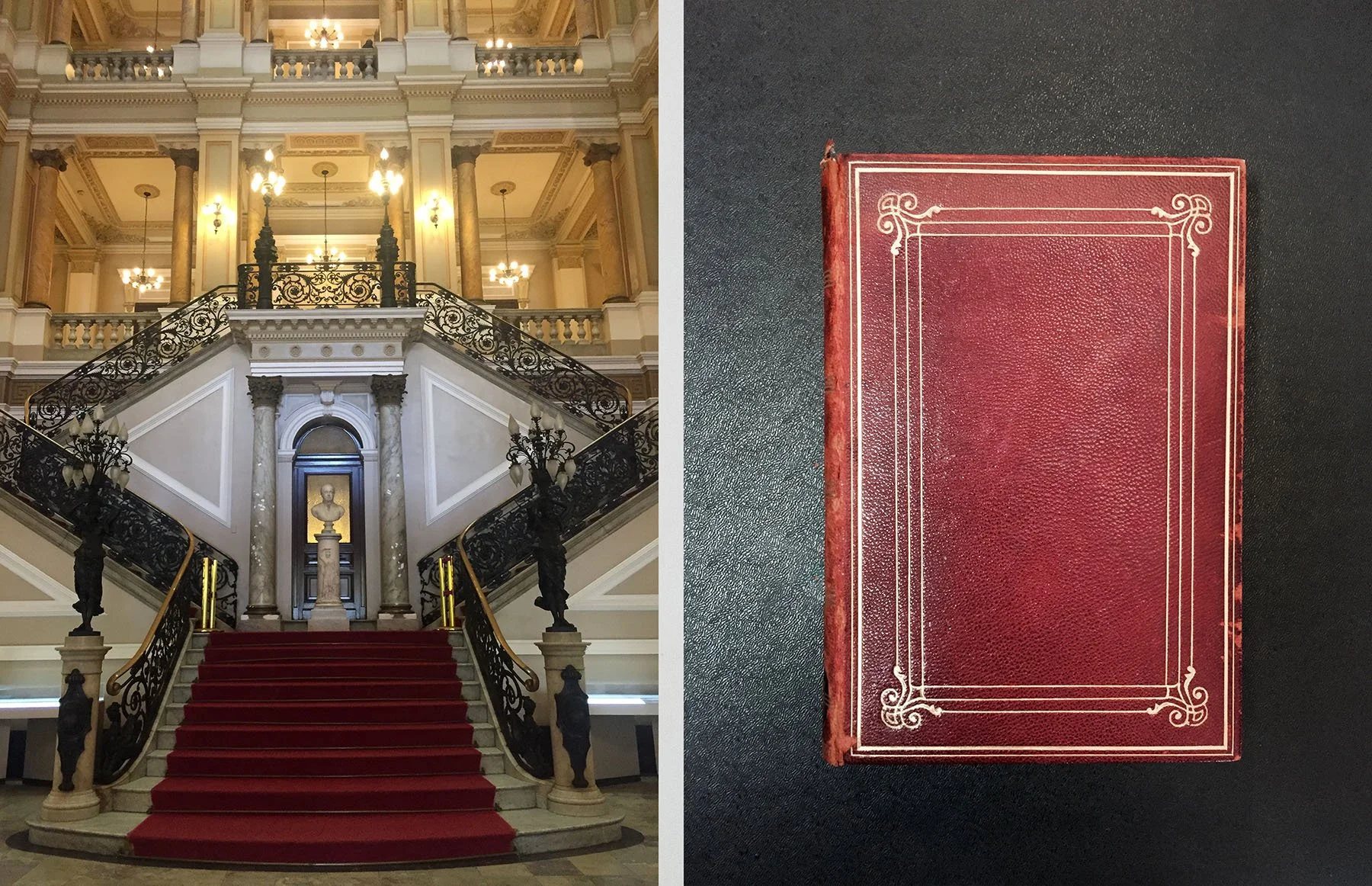
The Biblioteca Nacional in Rio de Janeiro, and the 1881 edition of Memórias Póstumas de Brás Cubas held in its rare books section. Photos by Raquel Castedo.
Memórias Póstumas de Brás Cubas (The Posthumous Memoirs of Brás Cubas) was published in 1881 by Machado de Assis, one of Brazil’s most important writers. Its narrator is dead: Brás Cubas tells the story of his life from beyond the grave, addressing the reader directly and breaking the rules of the novel along the way. What felt radical then still feels strange and modern now, which may be part of why the book has never stopped being read.
One of the copies of the first edition lives in the rare books section of the Biblioteca Nacional in Rio de Janeiro. It cannot be pulled from a shelf. It has to be requested, and the first time I asked to see it, in March 2015, during a research visit in the middle of my doctoral work, a librarian brought me the gloves I would need before I was allowed to touch it.
It is not a large book. Printed by the Tipografia Nacional in 1881, it was the first edition of the novel, after it appeared as a serial the year before. What I remember most is not the binding or the age of the paper. It is the blank space. The text sits inside generous margins, with room on every side. Every chapter begins on a new page, without exception, even the chapters that run three sentences long. The blank space is doing work: you feel where to pause because the page tells you. Someone decided that in 1881, and the decision is still doing its work on a reader wearing gloves more than a century later.
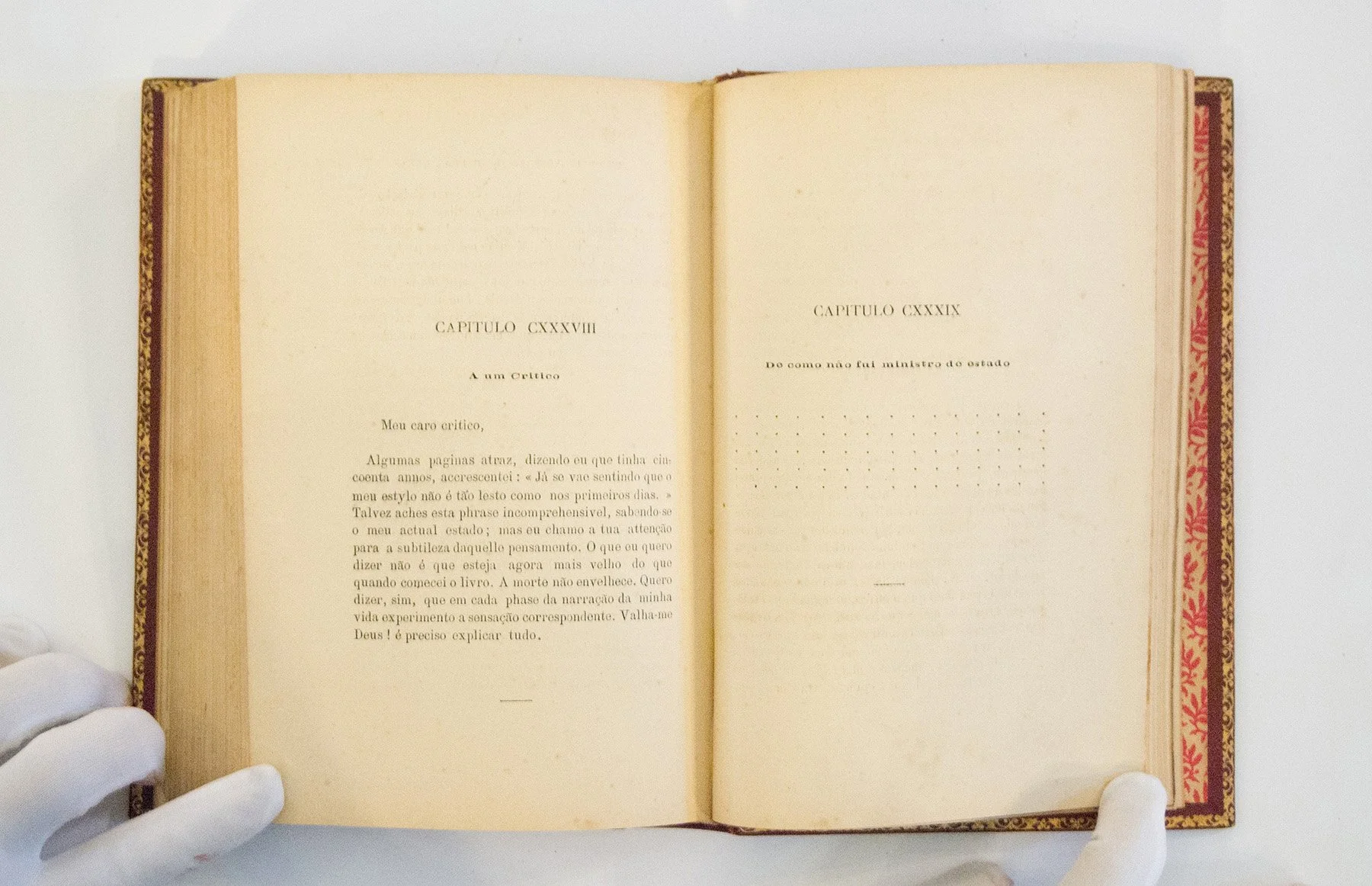
One chapter ends, and the next begins on a new page: at right, the chapter in which Brás Cubas explains how he did not become a minister of state, told almost entirely in ellipses. Tipografia Nacional, 1881. Photo by Raquel Castedo. Copy held by the Biblioteca Nacional, Rio de Janeiro.
In August 2018, I went back to Rio, this time for a month. On paper, it was a research trip: I wanted sustained time with the editions of the novel I had spent years studying. Underneath that plan was something less reasonable. I wanted to see the city Machado had known, or at least to understand what of it could still be recognized.
Around that time, there was even an app called Rio de Machado that mapped places from his books onto the contemporary city, a way of reading the Rio that existed through the Rio that was still there. I knew the city had changed enormously since the 1880s. Streets had been renamed, widened, demolished, and rebuilt. Other places were still there, layered with new histories. I went looking for the connections between them.
Most of my days that month were spent at the Academia Brasileira de Letras, the Brazilian Academy of Letters, which Machado helped establish and led as its first president. Its library was where I could see more editions of Memórias Póstumas de Brás Cubas gathered in one collection than anywhere else I had worked.
The librarian, Luiz Antônio de Souza, made those weeks possible. He would always receive me with a smile and seemed to know where the volumes were almost by heart. I arrived a stranger with an unusual request: a designer who wanted to look at the same novel over and over. He received me as if that were the most natural thing a library could be asked.
The Academia also holds Machado’s correspondence, published in a collection I read from during those weeks. In his letters to his Paris publisher, Hippolyte Garnier, the novelist discusses paper, typefaces, and the layout of his chapters. In one exchange, he asks for paper thick enough to give Dom Casmurro the same body as Brás Cubas. He had been an apprentice typographer as a teenager, and he never stopped paying attention to what his books were made of.
The blank space I had noticed in 2015 was part of a larger history of decisions around the book. The pages of his novels were not simply containers for his words. Paper was chosen, type was discussed, chapters were set and corrected.
I had first seen the 1881 edition three years earlier, during my doctoral research, before I understood any of this. I had noticed the generous margins and the way every chapter began on a new page, but I had understood them as features of the book. Reading Machado’s correspondence, I began to see them as choices.
The book was not simply carrying Machado’s words. It was carrying decisions about how those words should be encountered. The paper, the type, the space, the rhythm of the pages: these were part of the work, too. I had been looking for Machado in the city, but I was beginning to find him in the object.
I think about that afternoon when I am making books in Baltimore. Every publication that leaves the studio is, among other things, what our moment leaves behind. The paper we choose, the space we give a text, the care we take or do not take: that is what a reader in some distant year will hold as the world around the book changes, some things disappearing and others carrying forward.
A book crosses that distance only because people keep choosing it along the way: printing it, binding it, cataloging it, preserving it, bringing it to a table for a stranger in gloves. Luiz Antônio de Souza gave the Academia’s collection forty-seven years of that attention. In March 2020, during the pandemic, he was among the employees dismissed from the institution. He died of Covid a year later.
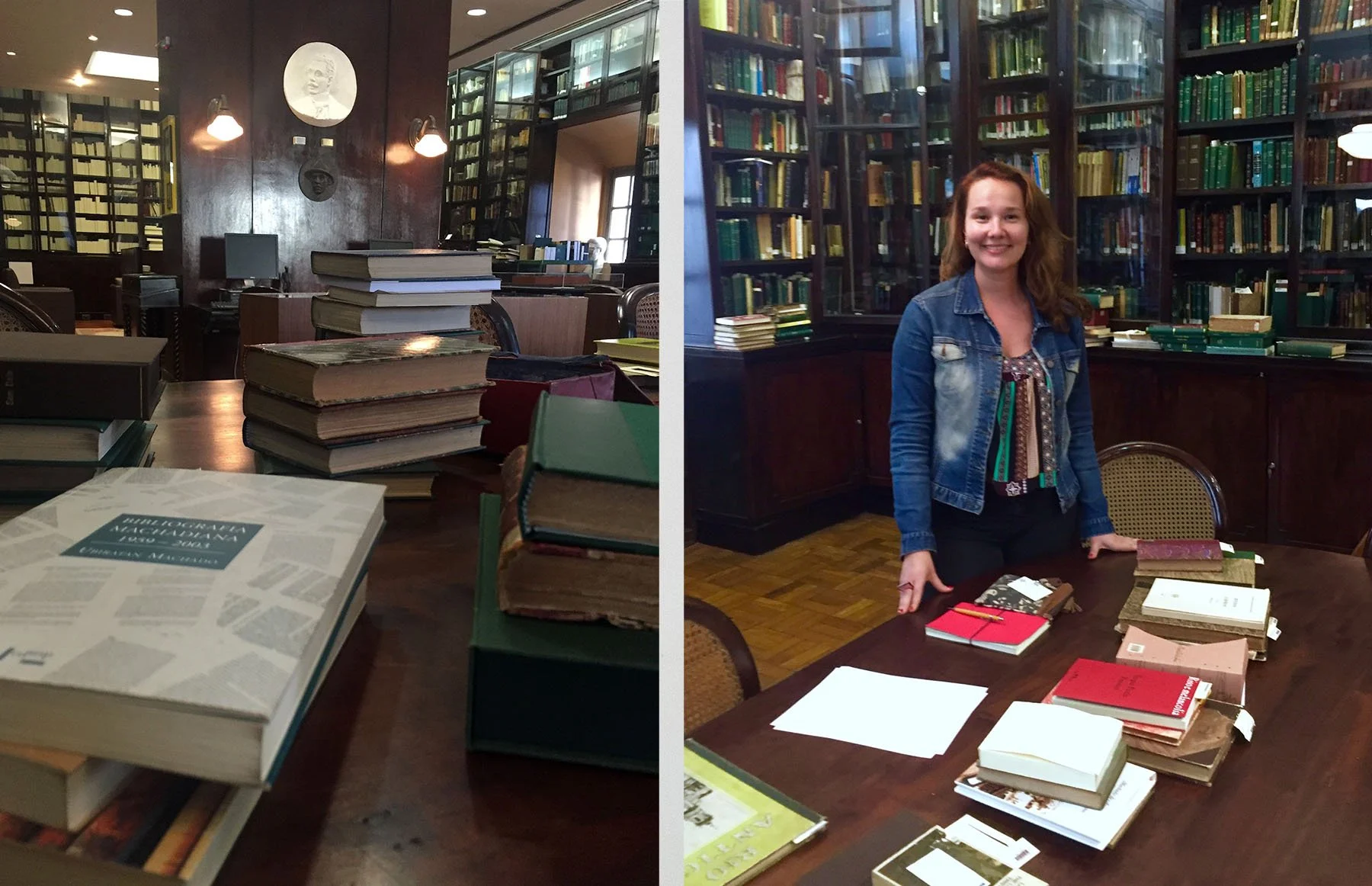
The library of the Academia Brasileira de Letras, August 2018. Photos from the author's research visit.
In early September, I flew home to Porto Alegre. I had not found Machado’s Rio preserved in place. I had found traces of it, and a book that had carried more than a century of them forward.
I took off the gloves and handed the book back.
Postscript
This essay draws on my doctoral research on the editions of Memórias Póstumas de Brás Cubas and on research visits to the Biblioteca Nacional and the Academia Brasileira de Letras in 2015 and 2018. That research later informed the chapter breaks and page layout of the 2020 Penguin Classics edition of the novel.
In memory of Luiz Antônio de Souza, librarian of the Academia Brasileira de Letras, who helped me navigate its collection in 2018.