A morning in Jackie Milad’s studio
Walking into Jackie Milad’s studio, I felt something close to luck. The collage tapestries covered the walls, large-scale works layered with Egyptian iconography, personal drawings, and that particular vibrant pink that runs through Jackie’s practice like a signature. Sixty handmade shabti sculptures, inspired by ancient Egyptian funerary figures, were arranged around the room, each one distinct. Vivian Doering, the photographer, was already set up and moving.
What struck me immediately was something Jackie describes in her own words: the shabtis seem to have walked right off the collage tapestries. In the studio, surrounded by both, I could feel that relationship. The small figures and the large surfaces were in conversation, already becoming the book.
That morning has stayed with me as one of the clearest examples I know of the book chain made visible in a single room.
I have written before about what book historians call the communication circuit of the book: the network of people and decisions that carries a text from an author’s mind to a reader’s hands. I often think of it more simply as the book chain. Most of those decisions happen months apart, in different places, among people who may never meet. What I witnessed in Jackie’s studio was unusual because part of that circuit briefly became visible all at once.
Jackie and I worked in what became a production line. We would decide which shabtis belonged together, sometimes by similarity of texture or scale, sometimes by contrast, depending on what each grouping needed. Each arrangement would go in front of a collage tapestry for Vivian to photograph, and then we would move to the next. The decisions were made in the room, with the objects in hand. Which shabti belonged next to which could not have been determined from a screen or planned in advance. It required the kind of knowledge that only emerges when people, objects, and ideas occupy the same space.
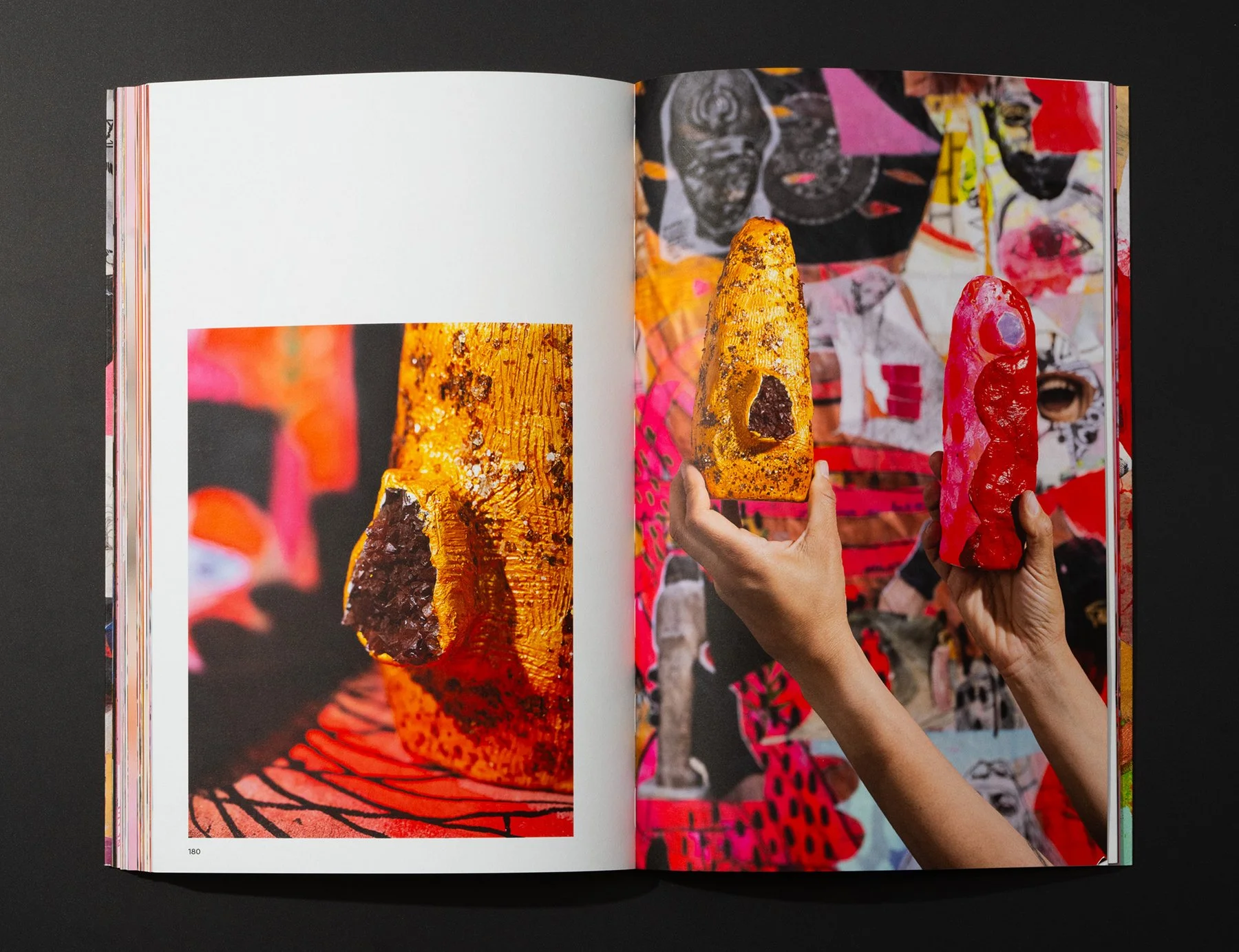
On the right-hand page, Jackie Milad holds sculptures from her Shabtis Gather series, photographed by Vivian Doering against one of her collage tapestries. Published in Shabtis Gather: Jackie Milad (BmoreArt, 2025), designed by Raquel Castedo Studio.
On the right-hand page, Jackie Milad holds sculptures from her Shabtis Gather series, photographed by Vivian Doering against one of her collage tapestries. Published in Shabtis Gather: Jackie Milad (BmoreArt, 2025), designed by Raquel Castedo Studio.
Jackie’s hands appear in some of the photographs. That was her instinct, not mine. She had spent time in museum study rooms, including the British Museum, the Petrie Museum, and the Walters Art Museum, holding ancient Egyptian shabtis with her bare hands. She had thought deeply about what it means to touch an object that someone made thousands of years ago, and what care is transmitted through that act. When her hands appear in the images, they carry all of that. They give scale to the shabtis, and they give the photographs something harder to name: the presence of the person who made these things and the quality of attention she brought to making them.
There is a line from those photographs back to those museum study rooms. There is another line forward to the reader who will eventually hold the book Shabtis Gather and feel, without quite knowing why, that this is an object worth keeping.
That is what the book chain does. It carries human presence from maker to reader through decisions that accumulate in a physical object. The designer’s role in that chain is not to arrive with answers already formed. It is to be present enough, in the room and in the relationship, to understand what the content needs to become.
I left Jackie’s studio that morning having learned more about her practice than any amount of time looking at her work on a screen would have taught me. That knowledge shaped every design decision that followed. Seeing the relationship between the collage tapestries and the shabtis firsthand changed how I thought about scale, sequencing, and pacing in the book. The collage works are visually dense and richly layered. If every page carried that same intensity, the reader would stop seeing it. I began introducing more space around certain photographs, giving the images room to breathe and allowing moments of focus between moments of visual complexity. The balance was delicate. Too much space would separate the works from one another; too little would flatten their differences. You cannot always see where that learning goes. But it is there, held inside the book.
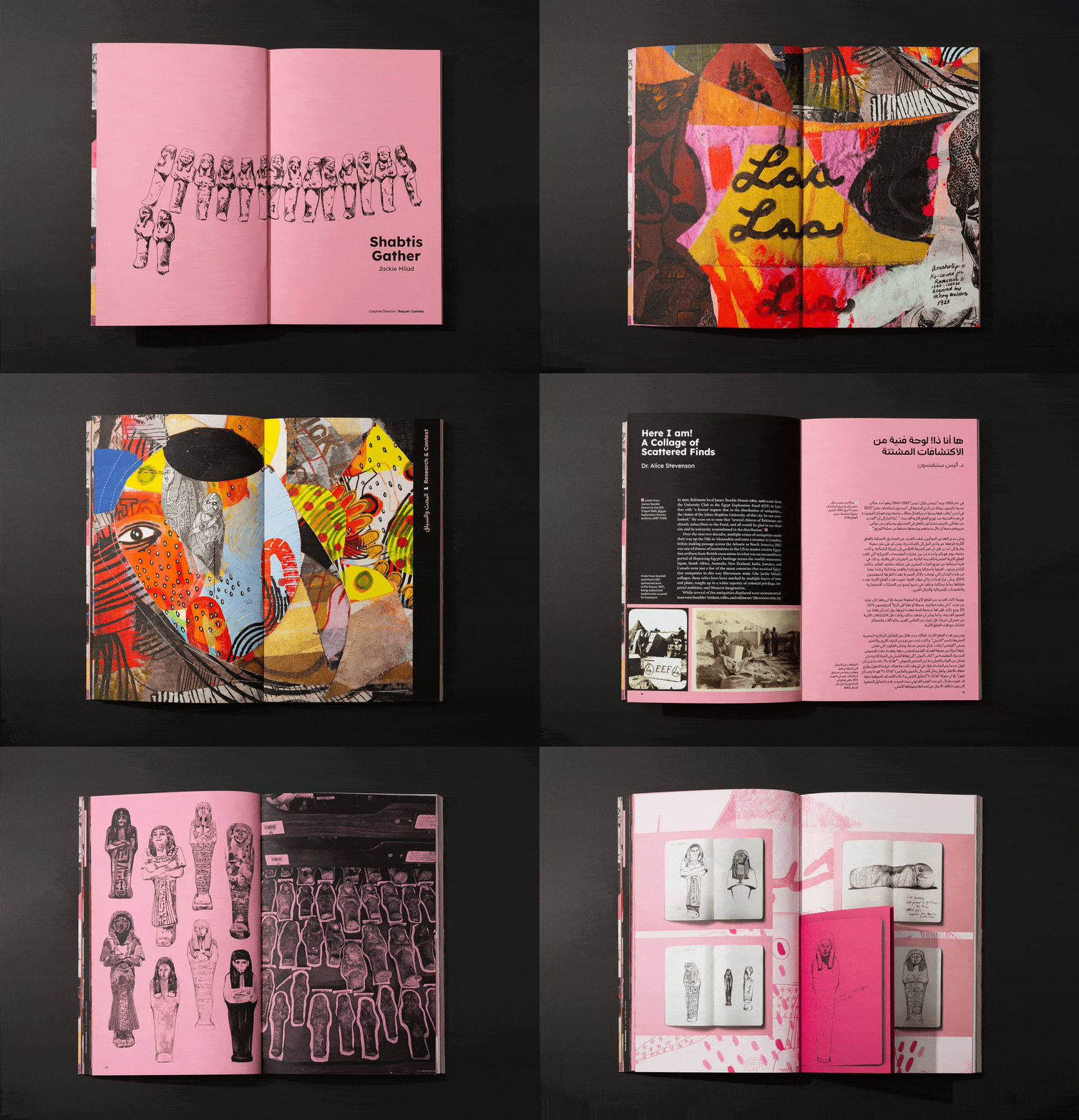
Shabtis Gather: Jackie Milad was released in September 2025. In ancient Egypt, shabtis were small funerary figures placed in tombs to accompany the dead into the afterlife. Milad reimagines this tradition through sculpture, collage, and drawing, creating contemporary shabtis that explore memory, migration, and fragmented heritage. The 200-page bilingual publication presents more than 150 images of Milad’s work alongside essays by Egyptologists Dr. Alice Stevenson, Dr. Fatma Ismail, and Heba Abd el-Gawad, in English and Arabic. Designed by Raquel Castedo Studio and published by the artist in partnership with BmoreArt, the book offers the most comprehensive presentation of Milad’s practice to date.
Three moments
1 At the paper sample table
There is nothing like visiting a printing plant and working through their paper samples by hand, running a finger across the surface, holding a sheet to the light to read its fiber, pressing two stocks together to feel the difference in weight and yield. I am deciding, in those moments, how ink will sit on this surface, whether it will be absorbed softly into uncoated paper or sit sharply on coated stock, and how that will affect every text block and every image in the book I am designing. What I learn in those moments comes entirely from physical contact with the material, and no screen can replicate it.
2 At the press
Checking press proofs, watching the machines run, talking to the printer about a color that needs adjusting on the press sheet. This is where the design is finalized in material terms, beyond what the screen shows. A color that looked right in proof behaves differently under the press, and the printer knows things I do not know yet. Those conversations are part of the work.
3 Holding the finished book
After being present at every step, paper selection, color proofing, binding decisions, finishing choices, receiving the finished book is a particular kind of reward and a particular kind of reveal. Throughout the entire process, I have been making decisions about things I cannot fully see until they are done. That gap between decision and result is where craft knowledge lives. I am drawing constantly on accumulated physical experience, using memory and imagination to see forward into a material reality that does not yet exist.
“I am constantly choosing processes and materials that we can only see once they are actually done. There is a lot of imagination that needs to be used, based on previous experience.”
On AI and the question of book craft
Books are already being made with AI assistance, and in some cases generated entirely by AI. I don’t find this, in itself, especially remarkable. AI can simulate the outputs of many people in the book chain — text, layout, image selection. It can produce something that looks like a book.
What it cannot do is accumulate the tactile knowledge that comes from years of physical presence in the production process. It has not stood at a paper sample table and felt the difference between two stocks with its hands. It has not had a conversation with a printer about a color that is pulling warm on the press. It has not held a finished book that it made decisions about six months earlier and felt the gap between what it imagined and what it holds.
That knowledge, sensory, embodied, accumulated through repetition, error, and presence, is what a skilled publication designer brings to the work. It is what makes a well-crafted book feel different from a generated one, even when a reader cannot name exactly why.
For designers at the beginning of their practice, this kind of knowledge is still available to be learned. It comes from being present where things are made, and allowing that experience to shape how you think and decide.
Benjamin knows this instinctively, at sixteen months. He holds the book in his hands and tests what it will do, learning in the most direct way possible what it means to encounter a designed object.
That stays with me every time I step into a production space.